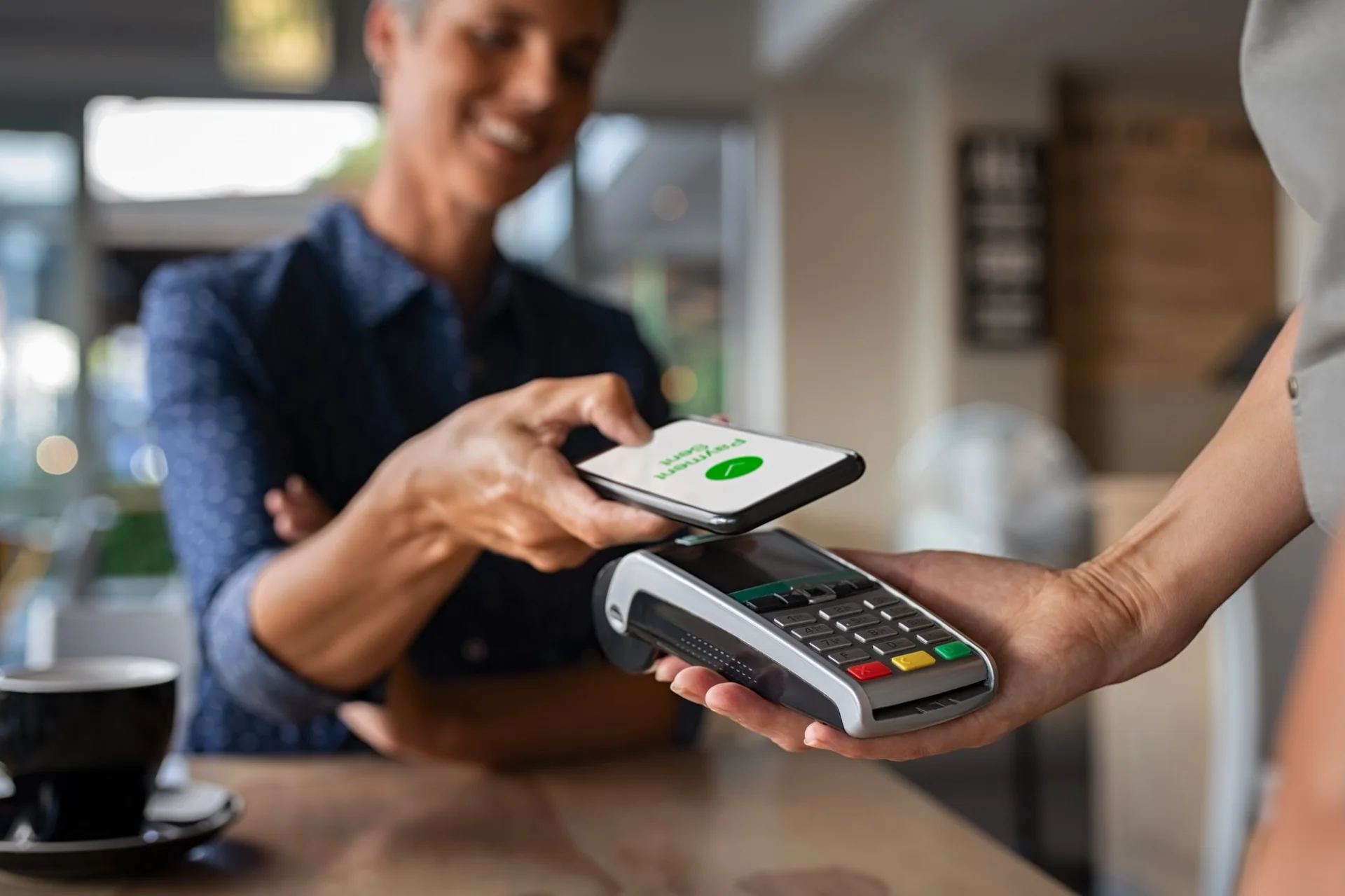

A guest holds a card over the reader, it beeps, and the meal is paid for. That is contactless payment: a card, a phone or a watch read over a short range radio link instead of being pushed into a slot. Below a local ceiling there is no PIN to type and nothing to sign, and most cards issued in the last decade already do it.
For a restaurant the honest version is narrower than the sales version. The tap takes about a second, and that second was never what made paying slow. The minutes sit either side of it: a guest waiting to catch someone's eye to ask for the bill, then waiting again while a machine is carried across the room. Contactless is worth switching on. It helps to know which of those waits it actually removes.
What Happens During a Tap
The card and the terminal talk over NFC, the same standard behind Apple Pay and Google Pay. From the terminal's point of view a tapped bank card and a tapped phone are the same kind of transaction, which is why accepting wallets does not mean buying separate hardware.
There is a ceiling on it. Above a per transaction amount set by the card schemes and your acquirer in your market, the terminal stops accepting a plain tap and asks for a PIN, and some terminals ask again after a run of consecutive taps on the same card. For a coffee this never comes up. A table of eight can pass it easily, so the PIN pad needs to be reachable at the table, not only the reader.
Three Places a Restaurant Can Take a Tap
Contactless describes how the card reaches the reader. Where that reader sits is a separate decision, and it is the one your guests feel.
| Setup | Who moves | What the guest waits for | What it needs |
|---|---|---|---|
| Reader at the counter | The guest, or a server walking the check over twice | The check to arrive, then the walk to the till | Nothing extra; this is the default |
| Handheld reader carried to the table | A server, once | A server to be free with the machine in hand | A mobile terminal and staffing that allows the trip |
| Guest pays from their own phone | Nobody | Nothing, once the bill is on their screen | A bill tied to the table and an online payment provider |
The first row is the default, because it is what a counter terminal already does. The second row is a real gain and a staffing question at the same time: a handheld only shortens the wait if somebody is free to carry it. The third row removes the trip completely, and it needs the bill to exist somewhere the guest can open, which in practice means the order was taken digitally in the first place.
Tips, and What Changes About the Card
Tipping decides whether a tap feels smooth or awkward. On a terminal the tip is a prompt the guest answers with a server standing there. When the guest pays from their own phone the same prompt is answered alone. Either way, settle with your provider how the tip is captured before you roll it out: some setups add it to the same authorization, others take it as a second one, and the two read differently on your end of day report.
The card also stops moving around the room. It cannot be left on a table, handed back to the wrong guest, or carried to a counter and back. The most common card incident in a restaurant isn't fraud, it's a guest who drives home without their card, and a tap removes it. Disputes get simpler for the same reason: if nobody on your staff handled the card, a skimming claim has nothing to attach to.
What to Ask Your Payment Provider Before You Switch It On
Contactless is usually a setting on a modern terminal rather than a project, which is exactly why it gets switched on without anyone checking what it changes downstream. Five questions cover most of it.
- Is contactless already enabled on the terminals we have, or does it need turning on?
- What is the tap ceiling in our market, and what does the terminal do above it?
- Does a tap cost us the same as a chip transaction, and do wallet payments carry a different rate?
- How is a tip captured, and does it appear as one line or two in the daily report?
- How does a refund work on a tapped payment, and does the guest need the same card or phone back at the counter?
Then measure the thing you are trying to fix. Over a representative stretch of service that covers at least one busy night and one quiet one, note the time between a table asking for the bill and the payment completing. Most of that number sits before the tap. If it does not shrink once contactless is live, the queue was never at the terminal.
Letting Guests Pay From Their Own Phone
The third row of that table is the one that has to be set up in advance, so here is what it takes. If a guest is going to pay without a terminal, two things have to be true: the bill has to be attached to a table, and the guest has to be able to open it without installing anything.
In FineDine the first one is a setup choice. You can print a separate QR code for each table, or one QR code for the whole room. Per table codes carry the table into the order without anyone typing it in. A room wide code is faster to print and to replace, and the table then has to be identified another way.
Payment itself runs through providers you already recognize. FineDine connects to Stripe, Square and SumUp, and to regional ones including Iyzipay and MOKA in Turkey and Myfatoorah and STC Pay in the Gulf. Card, Apple Pay, Google Pay, cash and tips are recorded against the order, so the check and the payment stay one record instead of two.
One more piece of the same problem: guests can send a service request from the menu, so asking for the bill does not depend on catching someone's eye. Dine-in, delivery and pick-up run as separate channels off the same menu, so a price change is made once. And when a guest settles the bill from their own phone, the tip prompt sits in that same step.
Contactless Payment Questions
- Is contactless payment the same as cashless?
- No. Contactless describes how a card or phone reaches the reader, over a short radio link rather than a chip slot. Cashless describes what you accept at all. A restaurant can be fully cashless without contactless, and it can take contactless while still taking notes and coins.
- Can a restaurant accept contactless only and refuse cash?
- That is a local rule rather than a platform setting. Some countries require a merchant to accept cash, others leave it to the business, and some cities set their own rule. Check with your accountant or the local authority before you put a card only sign on the door. This is not legal advice.
- Is tapping a phone safer than tapping a card?
- A phone or watch sends a device specific token rather than the card number, and the wallet asks for a face, fingerprint or passcode first. Your terminal treats both the same way, so there is nothing to configure differently.
- Does contactless still work if the internet goes down?
- Some terminals can hold a limited number of offline transactions and forward them when the connection returns. Whether yours does, and up to what amount, is set by your acquirer. Ask before a busy service is the moment you find out.